
Project displayed at the National Institute of Design, Annual Design Show 2024

Guide
Dr. Bhoumik Nagar
Shobhan Shah
Type
problem solving
design research
product design
toy and game design
Duration
6 weeks
Learning ~ Memory ~ Children ~ Play

Abstract
The following design project has been conducted to understand and provide a solution to memorization problems faced by children in their academics.
In the traditional educational approach, children often resort to rote learning and memorization to process and retain information. This method can lead to a shallow understanding of concepts, limited application of knowledge, and difficulty in retrieving information when faced with real-world problems. To address this issue, the project aims to shift the focus from rote learning to more effective learning strategies that promote deep understanding, critical thinking, and long-term retention.
Mathtrix is a gamified solution which currently focuses on mathematics and math tables for children to get to know, understand and learn tables using mnemonics.
The concept is designed and developed as part of an individual project of New Media Design at NID.
Process


“ I Hear and I Forget, I See and I Remember, I Do and I Understand. ”
- Confucius,
An ancient Chinese philosopher
Context
Exploring alternative teaching methods, such as mnemonic techniques, educators can help children develop stronger conceptual foundations, enhance their problem-solving skills, and foster a love for learning that goes beyond memorization.



What are Mnemonics ?

Any learning technique that aids information retention or retrieval in memory and helps in better understanding.
They can help children remember concepts by associating them with visual or auditory cues.
Parents and educators can use mnemonics in a variety of ways, such as songs, rhymes, acronyms, and memory games, to help children learn concepts in a fun and engaging way.
Secondary Research
Secondary Research was conducted through Literature Reviews and Articles


Why is Memory so Important for Children ?
Having a better memory allows children to store more information and helps them academically. In school, the learning process almost always requires a child to receive, retain, and recall whatever is taught in various subjects.
Children require an excellent working memory in the following sectors:
Focus and Attention,
Logic, Mathematics,
Reading,
Sports and Games


Why Mnemonics ?
Learning strategies like mnemonic techniques can aid in information retention and retrieval in human memory for better understanding. These techniques are usually based on different sensory cues and include tricks, acronyms, rhymes, songs etc to help remember. Eg: VIBGYOR to recall the colors of rainbow.
Children may sometimes struggle with paying attention for longer periods of time, which can make it difficult for them to effectively use these techniques. This is where the concept of learning through play comes in - by making learning fun, engaging, and interactive, children can learn without even realizing it.

Source : The Lego Foundation

Research Insights
Even today, lots of kids have trouble remembering multiplication tables. Rote learning methods are practiced for memorizing tables.
Practice is essential for effective learning, but it is important to keep a balance between practice and application.
86%
90%
of Indian classrooms don't use teaching materials other than the textbook.
accuracy is maintained by students after understanding multiplication strategies, and the same is maintained for addition strategies as well.
Primary Research
Interviews
I engaged with a set of 5 teachers, 7 parents and 7 children through online and offline interviews. This is a brief summary of those interviews followed by the research insights.

teachers
"In our classroom, I ensure that every child participates in the activities."
"We don't have time to teach mnemonics in class. We have to finish a lot of syllabus in the given time. "
"When a student seems distracted, I often ask them questions to bring their attention back to the lesson."
"We encourage independent exploration and critical thinking rather than spoon-feeding answers."

" We teach the fundamentals of multiplication. The child has to memorize the tables at home. "
"I know tricks to remember but don't have the time to teach and have to finish syllabus in limited time. "

parents
"I ask my daughter to recite the tables every day so that she remembers. I have also put up charts in the house. Thats how I learned too."
"Sometimes, it feels like I have to constantly remind my child to do her homework."
"While our child enjoys learning through screens, we're mindful of the impact it can have on their health."
"To facilitate learning, I create charts and visual aids for my child."
"I encourage my child to break down tasks into smaller chunks for easier understanding."
" I know that there is a trick to remember the table of 9. Rest of the tables; ratta "
children
"After school, I just wanna finish homework quick so I can go play."


"Math can be boring 'cause it's all about remembering stuff over and over."
"It's hard 'cause there's no fun stories or pictures in math."
"We love games 'cause they're super fun!"
"Math feels like too much writing and repeating, ugh."

Research Insights
Most parents are unaware of tricks and mnemonics used in math.
Parents resort to Rote learning methods for multiplication tables and push the child to memorize using repetition and recitation.

The school teachers who are aware of mnemonics or Math tricks and techniques have to stick to the conventional textbook methods due to academic and time constraints. Some teachers are unaware of mnemonic tricks in Math.
Children don't enjoy studying after school and just complete their homework so that they can go play.
Some children don't enjoy math because there aren't any stories or pictures involved.
Problem Statement
What are the problems faced ?
Lot of information to process
Rote Learning
Concepts remain weak
Struggle to recall information later
What is the focus age group and why?
6-9 yrs old
This is the period when the brain is developed to its maximum for lifelong learning. It is easy to tap in and clear certain concepts at an early stage.
What subject do children usually memorize using rote learning the most?
The multiplication tables, which encompass the basic arithmetic relationships between numbers, stand out as the prime example of a topic that is extensively rote learned.
These tables lay the foundation for more complex mathematical concepts and are a crucial building block for various mathematical calculations.

How might we facilitate effective learning through play at home for children aged 6-9 years using Mnemonics to improve their retention and understanding of multiplication and Math tables ?


User Personas
Design Ideations
Multiplication tables can be a challenge for many children.
This prompts the need for alternative methods like active learning and mnemonic techniques to improve memorization.
Learning through play helps children grasp and maintain attention and interest. Children develop their cognitive, physical, social, and emotional skills. Playful learning can have a positive impact on children's academic outcomes and overall growth.

Low Fidelity Prototypes


Form Exploration


Initial User Testing
Final Solution
Introducing,

Learning math tables through play
A game for children to learn and explore math table mnemonics to help them retain and recall multiplication tables.

About
Multiplication tables can be a challenge for many children.
MathTriX is a set of fun games for children aged 6+ to learn and retain multiplication tables using mnemonics.
MathTrix helps the child identify the patterns hidden within math tables which helps to recall and retain tables.
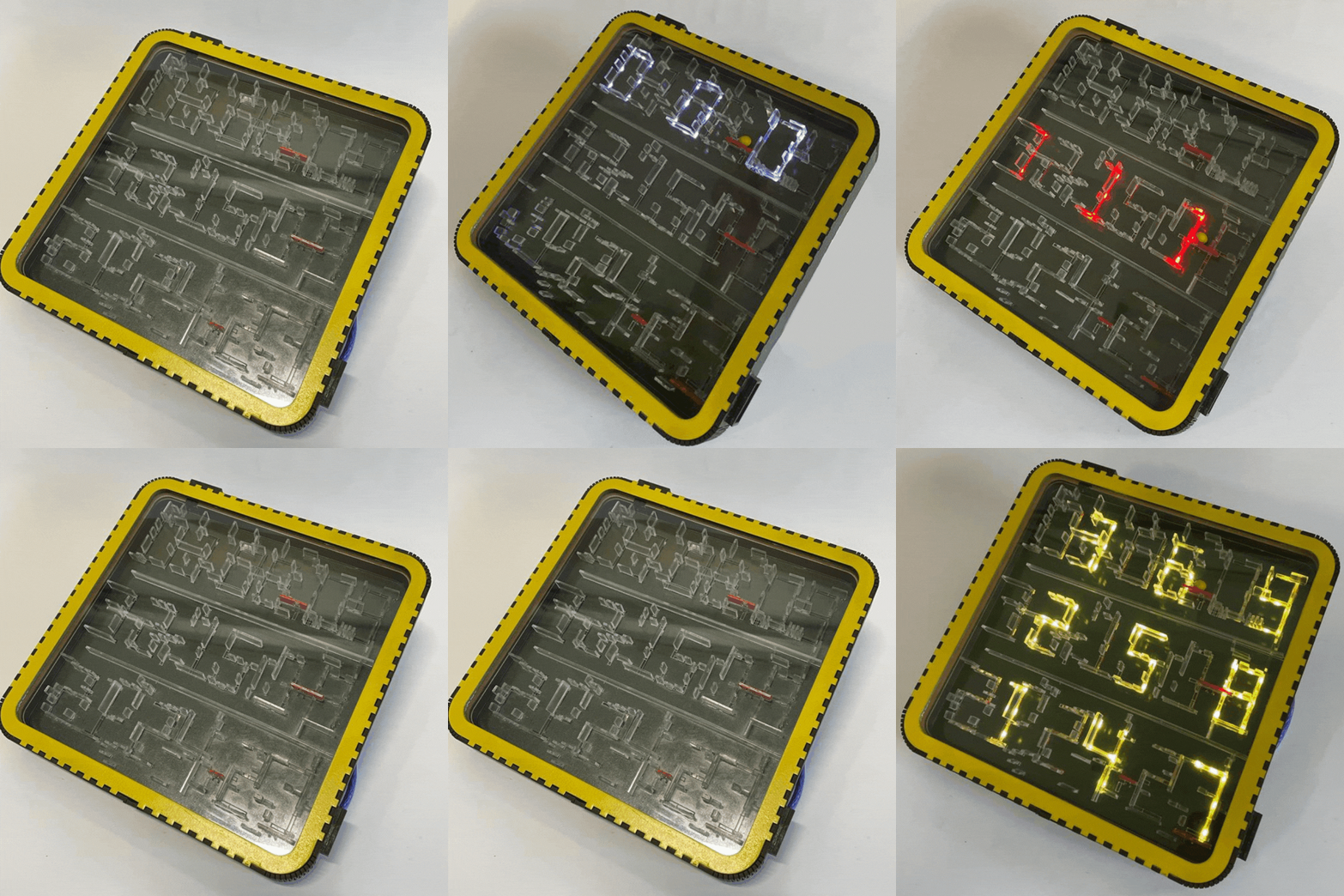
It comprises of Maze Games with engaging colored lights that capture the child's attention towards the patterns and other magnetic tile games which help the child apply the mnemonic.
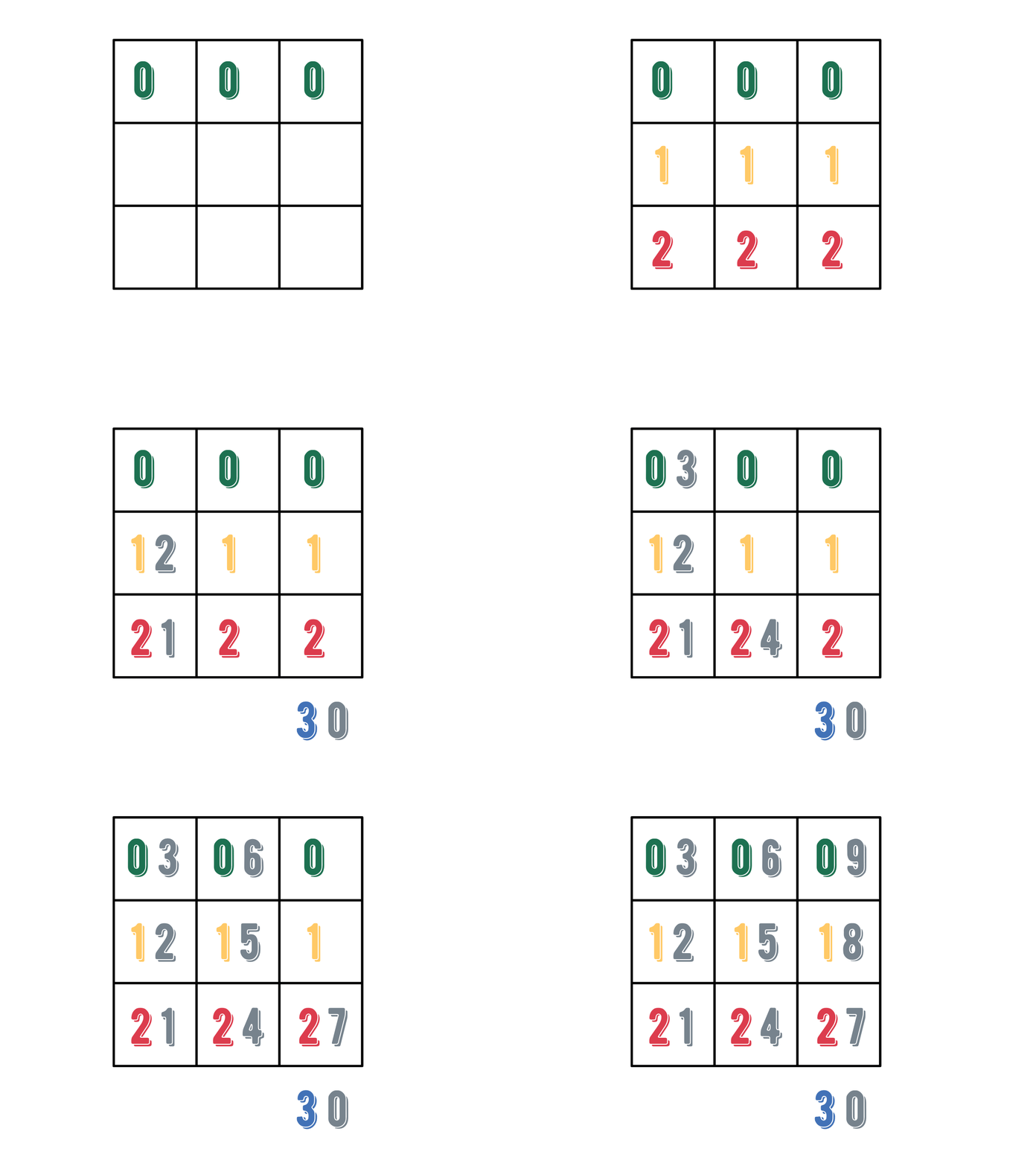
Mnemonic of Table of Three
Draw a 3 x 3 grid.
Fill 0, 1, 2 in each row in the units place.
Start from the bottom left corner and fill 1 to 9 in the units place.
Read the filled grid, row wise from left to right for the table of three.
Few Multiplication Table Mnemonics


Multiplication tables can be a challenge for many children.
MathTrix helps the child identify the patterns hidden within math tables which helps to recall and retain tables.
It comprises of Maze Games with engaging colored lights that capture the child's attention towards the patterns and other magnetic tile games which help the child apply the mnemonic.

How to Play
Pick up the maze board and rotate the board to get the ball through the maze.
Make sure that the ball touches the colored pieces as it passes.
Observe the digits that are formed as the lights appear and note the pattern of numbers.
Identify the multiplication table based on the patterns numbers lighting up.


Why choose MathTrix ?
Learning through Play
Visual and Kinesthetic Learning
Individualized Learning
Multiplayer Options

Uses mnemonics - tricks to remember
Screen-free play
Interactive and engaging
Customizable difficulty level
Branding

'MathTrix' represents the heart of engaging offline games for kids, aiming to make math enjoyable through play.
The name hints at methods for remembering math facts, especially through mnemonics.
Additionally, it cleverly plays on words with 'Matrix' due to its grid format and 'Math Trix.'
The tagline "math made fun" summarizes the mission of making math enjoyable for children.

Conclusion
This game started as a prototype focused on one math table but has the potential to expand to cover various other multiplication tables and math concepts, leveraging visual and kinesthetic learning.
It aims to incorporate additional arithmetic equations and will be connected to a mobile app for parents. The app will feature a 'progress tracking' function, allowing parents to monitor their child's learning journey for specific math concepts and gain insights into alternative playful learning methods at home.
Due to certain academic constraints, the mentioned features are still in the process of being developed.
